
Imagine driving a car that’s no longer serviced by the manufacturer. No spare parts, no safety upgrades, no technical support. Every kilometer you drive is a risk.
This is exactly what happens when businesses continue to use Microsoft Dynamics NAV beyond 2025.
Dynamics NAV has been a loyal companion for many companies, especially in the manufacturing, trading, and services industries. It offered flexibility, control, and customization that helped businesses grow steadily for years. However, technology doesn’t stand still—and neither should your business.
Microsoft officially ended mainstream support for NAV years ago. By 2025, even the extended support for many versions will stop completely.
The big question is, what happens if you still stick with it?
The Silent Risks That Grow Every Day
Without active support, Dynamics NAV becomes a ticking time bomb. Businesses will no longer receive security updates, leaving critical financial and operational data vulnerable to cyberattacks. In today’s connected world, one breach can cripple a business financially and reputationally.
Take, for example, a mid-sized trading company in Mumbai. They continued using NAV 2015 without upgrades. In early 2023, they suffered a ransomware attack through an unpatched security loophole. Recovery costs, customer loss, and downtime ended up costing them over ₹1.2 crore — a cost far higher than an ERP upgrade would have been.
Moreover, regulations are constantly evolving. In India alone, updates to GST e-invoicing, TDS rules, and compliance reporting standards have been rapid and frequent. Without regular system updates, your ERP can’t stay compliant, exposing you to penalties, audits, and heavy fines. One CFO shared that their team spent over 120 man-hours per month just manually adjusting compliance entries because their ERP couldn’t handle updated tax regulations automatically.
Losing the Race: Competitors Will Overtake You
While you struggle with manual workarounds, slow reporting, and error-prone integrations, your competitors are embracing automation, AI-driven forecasting, mobile access, and real-time dashboards.
They are cutting costs, improving customer service, and making decisions at the speed of light.
A manufacturer in Pune decided to move from NAV 2016 to Business Central SaaS in late 2022. In just six months, they reported:
- 20% faster order-to-cash cycles
- 15% reduction in operational costs
- Real-time inventory visibility across three locations
- Mobile approvals for purchase orders and dispatches
Their CEO mentioned:
“Earlier, I used to wait for the weekly report to understand my sales and inventory. Now, it’s on my phone, real-time. That’s the difference Business Central has made.”
Meanwhile, a peer company sticking to NAV continues to operate with last week’s numbers — making decisions based on assumptions, not reality.
Technical Challenges Will Multiply
Technology is moving towards connected ecosystems. You cannot run isolated systems anymore. Integrating NAV with new tools like Power BI, Microsoft Teams, payment gateways, CRM software, and modern supply chain platforms is becoming more complex and expensive each year.
In one case, a Bangalore-based distributor wanted to integrate their old NAV system with a new e-commerce platform. After months of struggle and ₹8 lakh spent on custom connectors and manual reconciliation, they abandoned the project and eventually migrated to Business Central — saving both time and future frustration.
Without modernization, every future innovation will cost you more, take longer, and deliver less value.
The Hidden Costs of Sticking with NAV
Many businesses hold back on upgrading thinking, “Why spend when it’s still working?” But the real costs are hidden:
- Increased IT maintenance and downtime
- Higher cybersecurity insurance premiums
- Loss of employees frustrated with outdated systems
- Customer dissatisfaction due to delayed service
- Missed business opportunities due to lack of real-time data
Over time, the “cost of inaction” becomes far greater than the “cost of migration.”
A Smarter Path: Transitioning to Business Central
Microsoft’s vision for the future is clear. Dynamics 365 Business Central is the natural successor to NAV — modern, cloud-first, continuously updated, and seamlessly integrated with Microsoft’s ecosystem.
Migration doesn’t mean you lose your data, processes, or expertise. It’s about upgrading your engine while keeping your core intact.
Companies that migrated report:
- 25–30% operational efficiency gains
- Reduced dependency on IT support
- Easier compliance management
- Happier, more productive employees
And the best part?
Business Central grows with you — whether you open a new plant, add an e-commerce channel, or expand globally.
Conclusion: Staying on NAV Post-2025 Is Like Sailing Without a Compass
If your business still runs on Dynamics NAV, think hard about your next steps.
Post-2025, it’s not just about missing a few features — it’s about risking your entire operational stability.
You owe it to your business, your team, and your customers to move to a system that’s ready for the future.
Because in today’s competitive world, being slightly slow is the same as being left behind.
Upgrade your systems before your competition upgrades their position.
Checklist
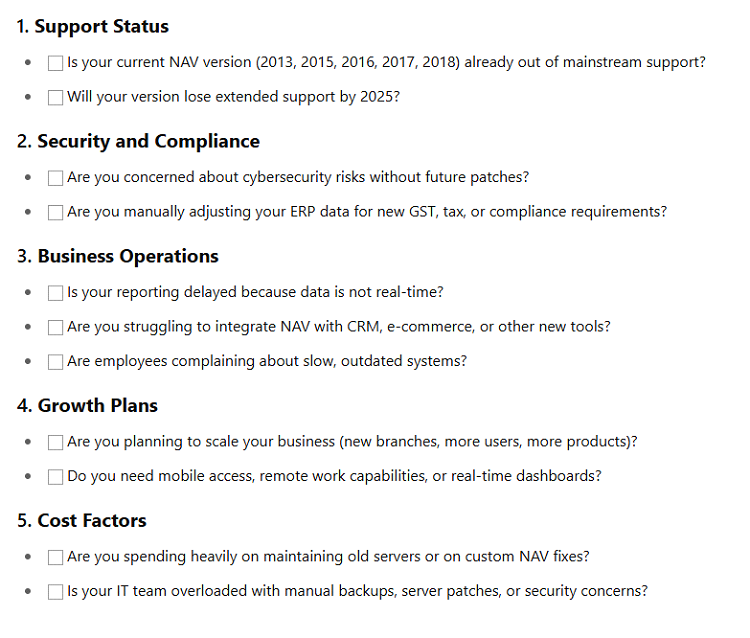
Your Scorecard:
| Number of Checkmarks | Recommendation |
| 8–10 | Immediate action required: Plan migration now. |
| 5–7 | Strongly recommended to migrate within 6–12 months. |
| 0–4 | Prepare a roadmap; migration needed soon. |
Ready to Migrate Smoothly?
We specialize in helping businesses like yours move from Dynamics NAV to Business Central with minimal disruption and maximum benefits.
- Data migration and integrity assurance
- Customization re-alignment
- User training and post-go-live support
Let’s future-proof your business — and set you up for the next decade of growth.